

 (3 votes, average: 4.67 out of 5)
 Loading...








Play Online Spider Solitaire for Free and enjoy a classic card challenge that’s easy to start and surprisingly hard to master. Build complete sequences from King down to Ace, clear full suits from the table, and use smart moves to uncover hidden cards.
Whether you prefer the relaxed pace of 1-suit mode or the deeper strategy of 2-suit and 4-suit versions, Spider Solitaire is perfect for quick breaks and longer sessions. It works smoothly in your browser, so you can play anytime on desktop or mobile, practice your strategy, and improve with every deal.
What is Spider Solitaire?
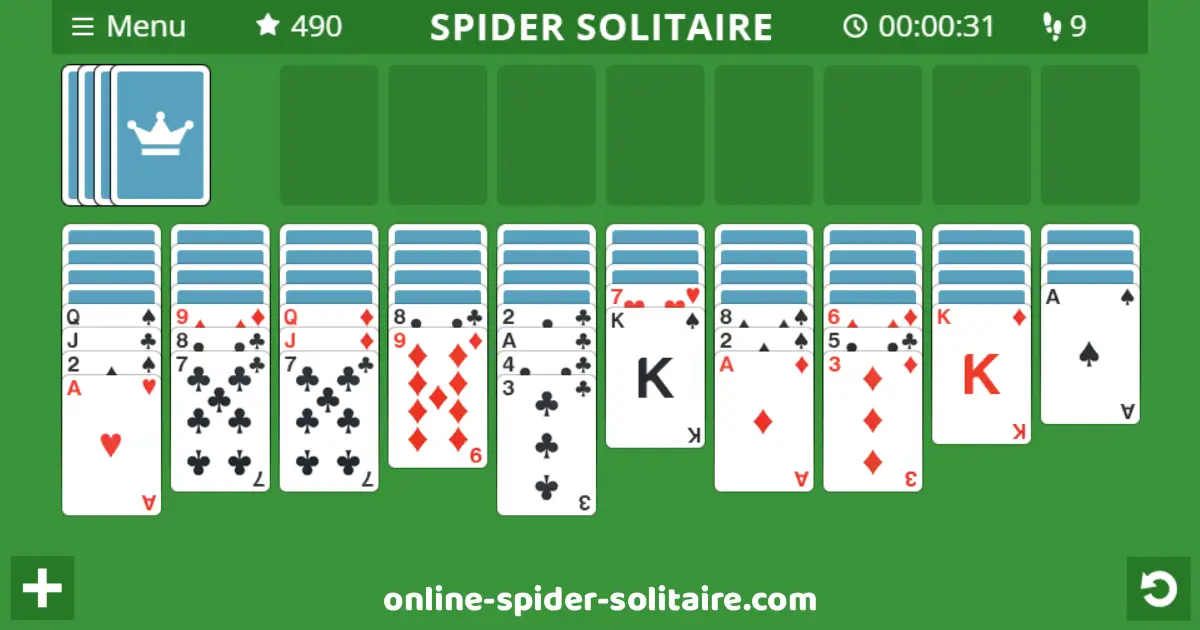
Spider Solitaire is a classic “patience” card game played with two standard decks (104 cards). The goal is simple: you build cards in descending order (King to Ace) and complete full same-suit sequences to remove them from the table until all cards are cleared.
About the “owner”: Spider Solitaire is a traditional card game, so it doesn’t have one single official owner like a modern video game. However, the version most people know on PC is Microsoft Spider Solitaire, developed and published by Microsoft. It first appeared for Windows users in the Microsoft Plus! for Windows 98 package on June 25, 1998, and later became a familiar part of Windows for many years.
In every game, you manage ten columns of cards, uncover hidden cards as you make moves, and decide the best time to deal new rows from the stock. You can also choose difficulty modes like 1 suit (easiest), 2 suits, or 4 suits (hardest), which changes how much strategy you need to win.
Spider Solitaire Quick Overview
Spider Solitaire is a classic card game played with two decks (104 cards). Your main task is to organize the cards into descending sequences, move them between columns, and uncover hidden cards. When you complete a full sequence from King down to Ace in the same suit, it can be removed from the table. The game becomes easier or harder depending on how many suits you play with.
Spider Solitaire Objective
Your objective in Spider Solitaire is to build card sequences in descending order, starting from King and ending at Ace. You can move cards to create longer runs and free up space, while trying to reveal as many face-down cards as possible. The best moves are the ones that help you form same-suit sequences, because only complete same-suit runs can be cleared from the board.
Spider Solitaire Winning Condition
You win the game when you clear all cards from the table. This happens by completing and removing full King-to-Ace sequences. Since Spider Solitaire uses two decks, you usually need to remove eight complete sequences to finish the game. If you get stuck with no useful moves and dealing new cards does not help, the round is considered lost.
Spider Solitaire Difficulty Modes
Spider Solitaire includes different difficulty modes based on the number of suits in play. 1 Suit is the easiest option because all cards follow the same suit, so forming complete sequences is simpler. 2 Suits is a medium challenge where you must plan better to keep suits together. 4 Suits is the hardest mode, using all suits, which makes it much more difficult to create clean same-suit runs. Beginners usually start with 1 Suit, then move up as they improve.
How to Play Spider Solitaire
Spider Solitaire may look complex at first, but the idea is simple: you move cards to build descending runs, reveal hidden cards, and complete full same-suit sequences from King to Ace. The better you organize the columns, the easier it becomes to clear the board.
Spider Solitaire Setup and Layout
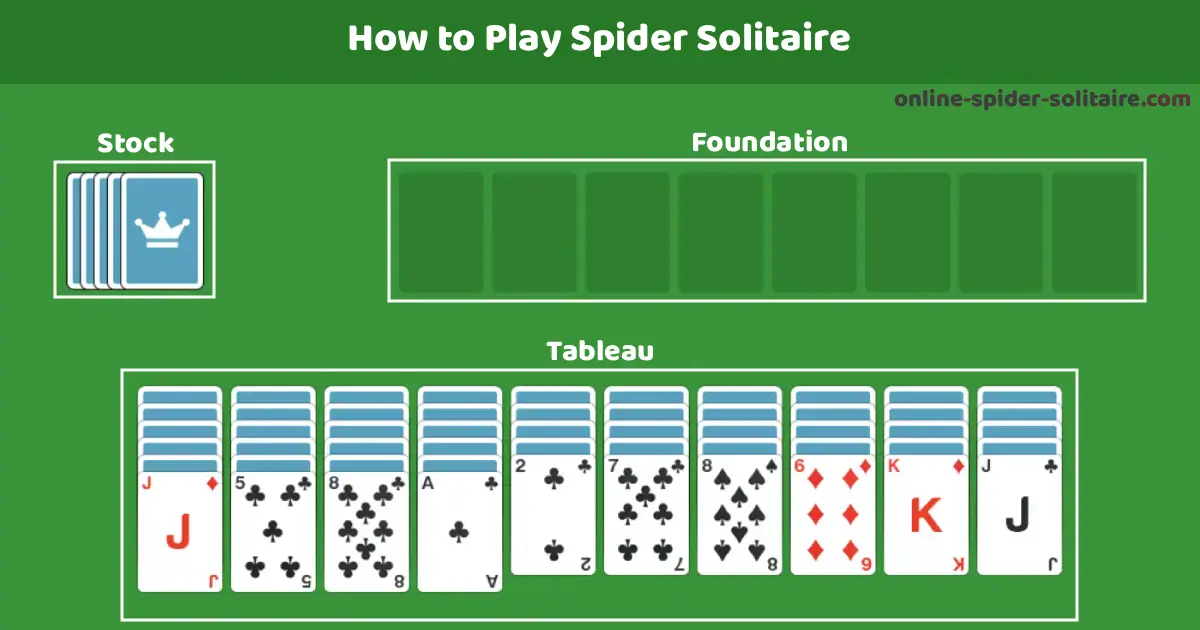
At the beginning of the game, two full decks are distributed across ten columns. The first four columns receive six cards each, while the remaining six columns receive five cards each. Only the card on top of every column is shown face up, and all other cards stay face down. Any cards that are not dealt are placed in the stockpile. Here is a quick breakdown of the items:
- Tableau: The 10 columns where you do most of the moving and building.
- Stock: The remaining cards you deal later to add a new row.
- Foundation: The area where completed K-to-A same-suit sequences are placed after they are cleared.
Moving Cards (Valid Moves)
You can move a card onto another card if the destination card is one rank higher. For example, you can place a 7 on an 8, or a Queen on a King. In many versions, this is allowed even when the suits are different. You can also move a group of cards together if they are already arranged in a descending order. An empty column is very powerful because you can place any card or any descending stack there to create space and open new moves.
Spider Solitaire Building Sequences
To make progress, you build descending sequences inside the columns, such as 10-9-8-7 and so on. Mixed-suit sequences can help you rearrange the table, but the strongest sequences are the ones in the same suit because they are easier to complete and clear. As you move cards around, try to reveal face-down cards whenever possible, because hidden cards often block the best moves.
Completing a Suit (K to A)
When you create a complete sequence from King down to Ace in the same suit, the game removes that full run from the table. This is a key moment because it frees space and makes the next sequences easier to build. To win, you must keep completing these full runs until no cards remain on the table.
Dealing from the Stock
When you run out of good moves, you can deal a new row of cards from the stock. This adds one card to the top of each of the ten columns, making the layout bigger and sometimes more challenging. It is usually smarter to deal only after you have organized the table, created space, and revealed as many hidden cards as you can. In some versions, you may not be allowed to deal if there is an empty column, so try to fill empty spaces before dealing.
Undo, Hint, and Auto-Complete
Many online versions include helpful tools to make the game smoother. Undo lets you take back the last move if you want to try a different plan. Hint suggests a possible move when you feel stuck, but it does not always show the best option. Auto-Complete finishes obvious moves automatically when the board is clearly set up, helping you end the game faster once victory is guaranteed.
Spider Solitaire Rules Explained
Spider Solitaire has a few core rules that control everything you do. Once you understand when you can move cards, what a full sequence looks like, and how to use empty columns, the game becomes much easier to plan and win.
When You Can Move a Card
You can move a card onto another card only if the destination card is one rank higher. For example, you can place a 9 on a 10, or a Queen on a King. In many online versions, you can do this even if the suits are different. You can also move a group of cards together when they are already arranged in a clean descending order. If a column is empty, you may place any single card or any descending stack there.
What Counts as a “Complete Sequence”
A complete sequence is a full run from King down to Ace. To remove a sequence from the table, it usually must be in the same suit from start to finish. Once the full same-suit run is formed, the game clears it from the board, giving you more space to organize the remaining cards.
Empty Columns: Best Use Cases
An empty column is one of the most valuable tools in Spider Solitaire. It acts like a free storage space that helps you move cards around without blocking important runs. The best use for an empty column is to temporarily hold a stack while you uncover face-down cards, rebuild cleaner sequences, or group cards by the same suit. Try not to fill an empty column too early unless it helps you reveal new cards or finish a strong sequence.
Scoring and Time (If Available)
Some versions of Spider Solitaire include a timer and a scoring system, while others focus only on gameplay. If scoring is enabled, your score may change based on moves, completed sequences, and how often you use undo or hints. Time is usually shown to track how fast you finish a round. Since rules vary from one version to another, it is best to treat the timer and score as a personal challenge rather than the main goal.
Spider Solitaire Controls
Spider Solitaire is easy to control once you know the basic actions. On most versions, you move cards by dragging them, or by clicking and placing them. The buttons for dealing new cards, undo, and hints are usually shown near the top or bottom of the game.
PC Controls
| Action | How to do it on PC |
|---|---|
| Select a card or a stack | Click the card (or the top card of the stack) to highlight it. |
| Move cards | Drag and drop the card or descending stack onto a valid destination card. |
| Quick move (if supported) | Double-click a card to move it automatically when a valid move is available. |
| Deal a new row | Click the Stock or Deal button to add one card to each column. |
| Undo the last move | Click Undo to step back one move. |
| Get a suggestion | Click Hint to highlight a possible move. |
| Fullscreen (if available) | Click the Fullscreen icon to expand the game. |
Mobile Controls
| Action | How to do it on Mobile |
|---|---|
| Select a card or a stack | Tap a card to select it. Some versions highlight the selected card. |
| Move cards | Drag the card or stack with your finger and drop it onto a valid card or column. |
| Tap-to-move (if supported) | Tap a card, then tap the destination column to place it automatically. |
| Deal a new row | Tap the Stock or Deal button to add new cards. |
| Undo / Hint | Tap Undo to reverse a move, or Hint to see a suggestion. |
| Best viewing mode | Rotate your phone to landscape for more space and easier dragging. |
Spider Solitaire Tips and Tricks
- Focus on revealing face-down cards early: Every hidden card can block important moves, so prioritize plays that flip new cards, even if the move looks small.
- Create an empty column as soon as you can: A free column works like a “storage space” that lets you rearrange stacks and fix messy columns.
- Use empty columns to build same-suit runs: In 2-suit and 4-suit games, park mixed stacks temporarily and rebuild clean same-suit sequences whenever possible.
- Delay dealing from the stock: Deal a new row only after you have made all good moves and improved the layout, because new cards can bury your progress.
- Avoid stacking low cards too early: Keeping small cards on top can trap higher cards underneath and make it harder to form long descending sequences.
- Keep columns balanced: Try not to leave one column overloaded while others are short, because balanced columns give you more choices and smoother moves.
- Break mixed-suit sequences when it unlocks a flip: A perfect-looking stack is not always best—if splitting it reveals a face-down card, it is often the smarter play.
- Build long descending runs before moving them: The longer the run, the easier it becomes to free space and complete a full King-to-Ace suit.
- Use Undo to test risky decisions: If you are unsure, try the move, check what it unlocks, and undo if it reduces your options.
- In 4-suit mode, protect your progress: When you start a clean same-suit run, keep it together and avoid mixing suits on top of it unless you must.
Spider Solitaire Variants and Difficulty
Spider Solitaire follows the same main rules in every mode, but the difficulty changes based on how many suits are used. The more suits in the game, the harder it becomes to build clean same-suit sequences and clear the table. If you are new, start with 1 Suit and move up as your strategy improves.
Spider Solitaire 1 Suit
1 Suit is the easiest version and the best place to learn. Even though the cards still show different suits, the game treats them as a single suit for building and clearing full sequences. This makes it much simpler to create long descending runs and remove complete King-to-Ace stacks. It is ideal for beginners, quick games, and practicing how to reveal face-down cards efficiently.
Spider Solitaire 2 Suits
2 Suits is a balanced mode that adds more strategy without feeling overwhelming. You play with two suits, which means you must pay attention to suit organization if you want to clear sequences smoothly. You can still build descending stacks with mixed suits to rearrange columns, but same-suit runs are easier to complete and remove. This mode is great for players who can win in 1 Suit and want a more realistic challenge.
Spider Solitaire 4 Suits
4 Suits is the hardest and most traditional difficulty. All four suits are used, so the table becomes mixed very quickly, and forming clean same-suit sequences takes careful planning. You often need to use empty columns as temporary storage, avoid dealing too early, and protect any strong same-suit runs you build. Choose 4 Suits if you enjoy complex puzzles and want the highest challenge Spider Solitaire offers.
Online Spider Solitaire
Online Spider Solitaire lets you play the classic card game instantly in your web browser, without downloading or installing anything. Just open the game, start a new deal, and enjoy smooth gameplay on desktop or mobile whenever you want. On our website, Spider Solitaire is completely free to play, so you can practice, improve your strategy, and replay as many rounds as you like with no signup required.
Free Spider Solitaire
Free Spider Solitaire means you can enjoy the full game online without paying any fees. You do not need to buy coins, boosters, or any in-game items to play and have fun. On our website, you can start a new round anytime, replay as often as you want, and focus on improving your skills with a classic card challenge that stays 100% free.
Spider Solitaire Free Download
If you prefer playing on your phone or tablet, Spider Solitaire is also available as a mobile download. You can find many official Spider Solitaire apps on Android and iOS through the official app stores, so you can play anytime, even when you are away from your computer. Always download from trusted sources and check reviews to choose the version you like.
- Download Spider Solitaire on Google Play
- Download Spider Solitaire on the App Store
Similar Games to Spider Solitaire
If you’re a fan of Card Games, you’ll definitely enjoy these too:
Spider Solitaire Frequently Asked Questions
What is Spider Solitaire?
Spider Solitaire is a classic card game where you arrange cards in descending order and clear the table by completing full King-to-Ace sequences, usually in the same suit.
Is Spider Solitaire free to play?
Yes. Many online versions let you play for free in your browser.
How many cards are used in Spider Solitaire?
Spider Solitaire uses two decks, which is 104 cards in total.
What is the main goal of Spider Solitaire?
Your goal is to remove all the cards by making full sequences from King to Ace.
What counts as a “complete sequence”?
A complete sequence is a full run from King down to Ace, usually in the same suit, so it can be cleared from the table.
Can I move cards even if the suits are different?
In most versions, you can place a card on another card that is one rank higher, even if the suit is different. Same-suit runs are still better for clearing.
Can I deal new cards if a column is empty?
In many Spider Solitaire versions, no. You must have at least one card in every column before you can deal a new row.
When should I deal from the stock?
Deal a new row when you have no good moves left and your columns are as organized as possible.
Which mode is easiest: 1 Suit, 2 Suits, or 4 Suits?
1 Suit is the easiest. 2 Suits is medium. 4 Suits is the hardest.
Is every Spider Solitaire game winnable?
No. Some deals are very hard or not possible to win, especially in 4 Suits mode.
How does scoring work (if the game has a score)?
It depends on the version, but many games give points for progress and remove points when you use Undo. Some also use time and bonus points.
Can I play Spider Solitaire on mobile?
Yes. Many websites and apps support Spider Solitaire on phones and tablets.